The SMB AI Paradox: The More Trust You Earn, the More AI Customers Want
When we started building the AI Treasurer for companies at Fonder, I expected the first question to be: What else can AI do?
It was not.
The first question was usually close to: Can I trust this with my numbers?
That makes perfect sense. In an SMB, cash flow is not an abstract dashboard metric. It is payroll next week, a supplier relationship, a loan payment, and the margin for error a team does not have.
But something interesting happens after the product proves itself.
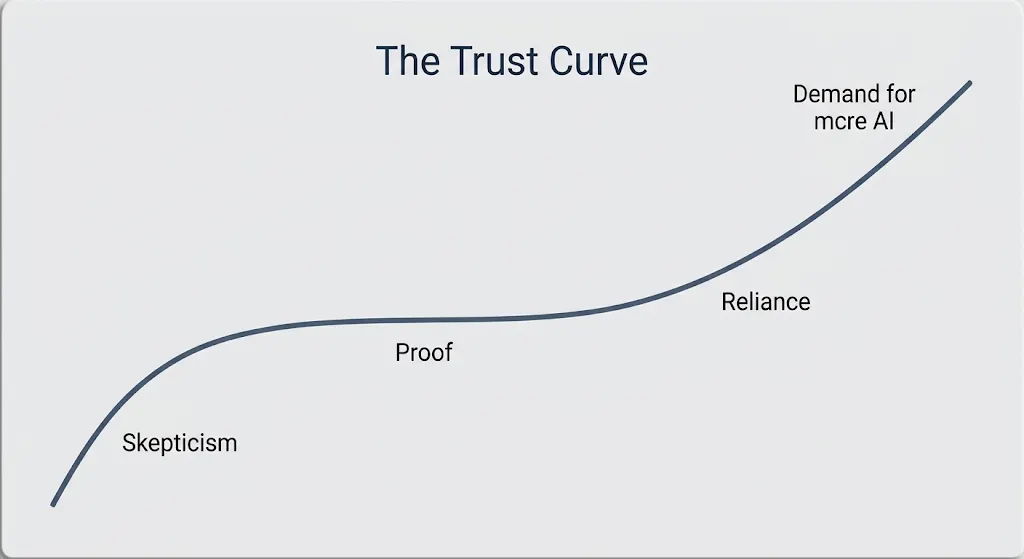
Once customers see that an AI workflow is accurate, useful, and grounded in their actual data, the question changes. They instantly start asking for more:
Can it also help me with collections? With forecasting? With finding what changed?
That is the SMB AI paradox: customers may begin with skepticism, but trust does not merely remove resistance. It creates demand.
SMBs do not want AI everywhere
The current AI conversation often assumes that adoption is mostly a feature-discovery problem. Add a chatbot, place an “AI-powered” badge in the navigation, and users will find a way to use it.
That is rarely how SMB software works.
Small and medium-sized businesses are not looking for AI because it is technically impressive. They are looking for fewer surprises, less manual work, and better decisions with limited time and limited people.
That distinction matters.
A finance lead does not wake up wanting a generative interface. They wake up wanting to understand why the bank balance does not match expectations, which invoices are likely to be collected late, or whether they can make a payment without creating a cash problem two weeks from now.
AI becomes valuable when it shortens the distance between those questions and a reliable answer.
This is why the initial bar is high. The more consequential the workflow, the less tolerance there is for a confident but wrong response.
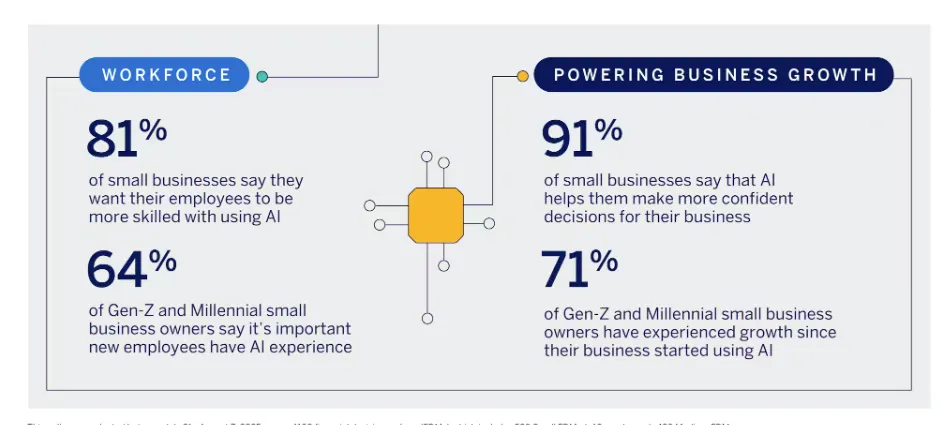
Research reflects that tension: in American Express’s 2025 survey, small businesses cited cost, relevance, security, and accuracy concerns as reasons to hesitate on AI adoption. At the same time, usage continues to grow rapidly. American Express
The contradiction is only apparent.
SMBs are not anti-AI. They are anti-unnecessary risk.
The first win has to be concrete
Trust is not built through a long security page, a polished onboarding flow, or an explanation of the model behind the feature.
Trust is built when the product helps someone do their job better on a Tuesday afternoon.
For one customer, that might mean correctly identifying a discrepancy that would have taken hours to trace across banks and spreadsheets. For another, it might mean surfacing a cash-flow risk early enough to change a payment decision.
The important part is not that the system said something intelligent. The important part is that the user could verify it, act on it, and see the result. Even better, at Fonderwe are already acting on their behalf; we are the ones responsible for making the decision.
At Fonder, we have seen that customers rarely ask for autonomy as a starting point. They want assistance they can inspect. They want the system to show what it found, connect the recommendation to the underlying data, and leave the final decision with them.
That is not a limitation of the product. It is the correct path to adoption.
In high-trust workflows, the first job of AI is not to replace judgment. It is to earn the right to support it.
Accuracy changes the relationship
There is a meaningful difference between a user trying an AI feature and a user relying on it.
Trying is cheap. Relying is expensive.
When an AI feature is wrong in a low-stakes context, it is annoying. When it is wrong in finance, operations, or customer commitments, it creates more work than it removes. That is why accuracy is not simply a technical metric for SMB products. It is a product strategy.
The OECD’s work on AI adoption among SMEs makes a similar point: smaller businesses face practical constraints around skills, resources, and risk that make responsible, useful implementation more important than generic enthusiasm. OECD
A useful AI feature earns its place by being right often enough, transparent enough, and valuable enough that going back to the old process feels worse.
Trust expands sideways
The most valuable signal is not the first time a customer uses AI. It is what they ask for next.
Once a team trusts the product to help explain one cash-flow anomaly, it starts asking for earlier warnings. Once it trusts a forecast, it asks for help prioritizing collections. Once it trusts the reconciliation process, it asks where else the system can remove repetitive work.
Trust moves sideways through the workflow.
This is the part many product teams miss. AI adoption is not always a funnel from awareness to activation to retention. In SMB software, it can be a widening circle.
One trusted workflow creates permission for the next one.
That permission cannot be bought with branding. It has to be earned through a sequence of small, credible wins.

A narrow feature that becomes indispensable is strategically more valuable than a broad AI layer that users keep at arm’s length.
The opportunity is to earn permission
There is still enormous room to build AI products for SMBs. They need leverage more than most organizations do: fewer people, less time, and very little room for operational noise.
The winning products will be the ones that understand where judgment matters, make their work legible, and prove their value before asking users to hand over more control.
AI adoption in SMBs is not a race to replace the human in the loop.
It is a race to become the product that the human trusts enough to invite deeper into the loop.
The question is not how much AI an SMB will tolerate.It is how much AI it will ask for once trust is earned.
At Fonder, we are already trusted by companies across more than six countries.
Our ambition is to earn that trust workflow by workflow, until AI can take on more of the repetitive and operational burden with the reliability that finance teams require.
We do not want to build AI for the sake of automation. We want to become the trusted AI treasurer for companies everywhere: a system that gives teams more visibility, better judgment, and eventually, the confidence to let software do more.